
BOP Quay Release Routes
The Federal Bureau of Prisons manages sentenced federal prisoners. A person with Quay County ties may serve a federal sentence at an institution elsewhere, since no BOP facility was identified locally. At the end of BOP custody, the person might enter the community, begin federal supervised release, transfer to another sovereign, or move into immigration custody.
A locator result showing “Released” and a date establishes the BOP record's release event. It does not prove that every hold was cleared. “Not in BOP custody” is broader and does not state why BOP lacks custody. It can reflect a different custodian or stage, so the federal docket and relevant agency must be checked.
Confirm a BOP Release
The official BOP Inmate Locator covers federal inmates from 1982 to the present. A register number or another accepted federal identifier is the best key. Name searches add age, race, and sex filters, but every match still requires careful identity comparison.
- Search by BOP register number or another accepted federal identifier when known.
- Otherwise enter the name and use the available demographic filters with care.
- Open the matching result and copy the exact status, location, and release-date label.
- Read BOP's records explanation before interpreting “Released” or “Not in BOP custody.”
- Review the federal court docket for sentence, commitment, supervision, and later orders.
- Check any receiving state, county, or ICE system named in the record.
The Quay County release search helps determine whether the last known custody was county, state, or federal before the BOP locator is used.
BOP Records and Contact
Because no Quay County BOP facility was found, contact should follow the institution or office shown in the federal record. The locator is the national search route. BOP's About Our Records page explains coverage and status limits.
Federal Bureau of PrisonsNationwide federal prison system
No BOP facility identified in Quay County
Use the locator result for the responsible institution
Use the federal docket for case orders
For a historical record, keep the register number, full name, institution, status label, and date. If another hold may exist, ask for the transfer or release record that names the receiving authority. A record from the Quay County Detention Center or NMCD must be requested from that separate agency.
The official BOP locator capture shows the appropriate federal released-person search.
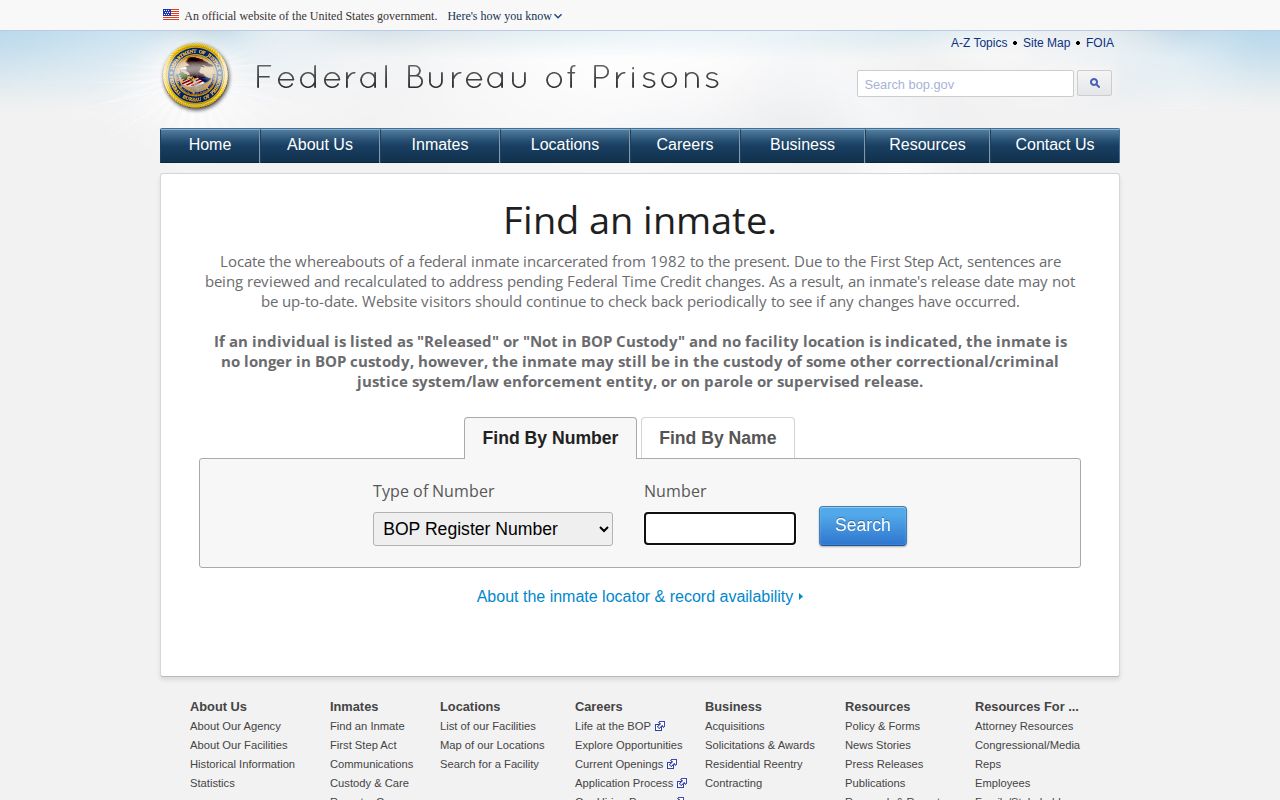
The locator reaches federal prison records, while local detention and state corrections remain outside BOP jurisdiction.
BOP Status Record Meanings
Federal status language must stay tied to BOP. A person can leave BOP and enter another form of legal control. The result should be reported as a BOP event with its date, followed by a separate statement about what is and is not known next.
| BOP finding | Supported statement | Required follow-up |
|---|---|---|
| Current institution | BOP identifies current federal prison custody | Verify movement with BOP when time-sensitive |
| Released with date | BOP custody ended as recorded on that date | Check supervision and receiving authority |
| Not in BOP custody | BOP does not currently hold the person | Use docket, USMS, ICE, or other custodian |
| No match | No result was located with the search used | Check identifiers, spelling, dates, and system |
No match must not be rewritten as release. The person could be in USMS pretrial custody, outside locator coverage, recorded under another spelling, or never committed to BOP.
BOP Versus USMS Custody
USMS often manages federal pretrial custody and prisoner transport. It may house people in contract beds rather than a Marshals-owned jail. BOP generally becomes the relevant locator after federal commitment, but a person still in a pretrial stage may not appear as a current BOP prisoner.
USMS has no general public prisoner locator comparable to BOP. Use the federal docket, defense counsel, or the District of New Mexico. Do not treat a BOP “Not in custody” message as proof that USMS custody ended. The two agencies describe different roles and time periods.
- USMS custody
- Federal pretrial, transport, and related prisoner custody managed by the Marshals Service.
- BOP custody
- Federal prison administration, generally after commitment.
- Supervised release
- Court-ordered federal supervision after imprisonment, distinct from BOP confinement.
- Detainer
- A request or legal basis for another authority to take custody.
BOP Quay Detainer Checks
A detainer can redirect a BOP departure. State charges, county warrants, another federal matter, or immigration action may affect where the person goes. The BOP release date still documents the federal prison event, but it does not answer whether the person entered the community.
Look for receiving-authority information in the release or transfer record and federal docket. If ICE is involved, use the ICE locator with the A-number and country of birth or biographical data. If New Mexico takes custody, use NMCD or the named county facility. Keep the systems separate in the timeline.
Note: A federal prison release date is not proof that every state, county, immigration, or court hold was cleared.
BOP Quay Historical Records
The locator's stated coverage begins in 1982. For an older event or a disputed result, the court file and agency records become more important. Search the federal docket by case and party, then compare the judgment, commitment, sentence, release result, and supervision terms.
Names alone are weak identity proof. Use the register number, full legal name and variants, age or birth information when lawfully available, case number, institution, and dates. Do not merge a Quay County state or local case with a federal person merely because names match.
A sound conclusion states the narrow fact: BOP recorded release on a certain date, BOP currently identifies an institution, or no BOP result was located. Then it lists the source needed to answer the remaining question.
For a federal sentence, the judgment and commitment establish the term imposed. The BOP result supplies the agency's current or historical custody status. A probation office record or docket entry can describe federal supervised release after prison. None should be substituted for another. If the dates conflict, obtain the actual documents and ask the responsible office to explain its own record rather than calculating a new date from a sentence summary.
A Quay County connection can arise from residence, arrest, conduct, a witness, or a later destination. It does not place the federal prisoner in a local BOP site. Record the federal case district, institution, register number, and release label. Those facts make it possible to distinguish the person from someone with a similar name and to trace the correct agency.
Release to federal supervision also differs from unconditional discharge. Supervised release is a court-ordered period after imprisonment. It is administered in the community and can include case-specific conditions. The BOP locator may show that prison custody ended, while the court file explains the supervision term. A violation can cause later detention without changing the historical BOP release date.
When USMS handled the person before BOP, the earlier pretrial history may not appear as a prison release entry. Review the docket from the first appearance through commitment. If the person never received a BOP sentence, the BOP locator may be the wrong tool. Use USMS district contact and the court instead.
Keep a dated record of the search terms used. If no match appears, repeat with the federal identifier and documented name variants. Report only that no BOP match was located. Do not infer acquittal, release, deportation, or current location from the negative result.
When a result is found, save the official status wording and access date, then verify the person against the federal case. A date without the right identity is not useful proof. A correct identity without the right custody system is also incomplete. The register number, case number, and institution provide the strongest cross-check.
That record chain also shows whether the federal event truly ended confinement or merely shifted the person elsewhere.
For a fully documented Quay County federal record, when a BOP release is followed by community supervision, the federal probation office and court docket hold the later status, not Quay County detention. If the person is returned on a violation, a new custody event may appear after the original release date. Keep both dates. The historical release remains accurate, while current liberty requires a current source. This distinction avoids the common error of treating any old “Released” label as a statement about the person's status today.
Keep every Quay County and federal event clearly separated, dated, and sourced.