
Quay Projected Versus Actual Release
A projected release date is an administrative estimate based on the information then controlling a sentence. An actual release date records the custody event that occurred. The two can match, but they answer different questions. A date may move because credit is corrected, deductions are earned or forfeited, a judgment is amended, parole is denied, or another agency has a detainer. A detainer is a request or legal hold that can keep a person in custody or route the person to another authority.
County detention adds another distinction. A person awaiting trial at Quay County Detention Center has no sentence expiration to calculate. Bond may be posted, a judge may change release conditions, charges may be dismissed, or another hold may remain. A person serving a short county sentence may have an expected end date, yet no Quay County online calculator or published jail good-time policy was found.
The actual Quay County event is established through the detention transaction and court authority. A move to NMCD, ICE, USMS, or another jail is a transfer, even though the person left the county facility.
Find Quay County Release Dates
Begin with the last known custodian. NMCD expressly says it has no jurisdiction over county or city detention facilities, so its search cannot calculate a Quay County jail date merely because the case arose in Quay County. Conversely, the county detention office cannot provide the authoritative time computation for an NMCD prison sentence.
- Identify whether the person is in Quay County detention, an NMCD prison, federal custody, immigration detention, or another jail.
- Obtain the signed judgment and sentence, plus later amendments, from New Mexico Courts Case Lookup and the responsible clerk.
- For NMCD, search by offender number or exact name through the NMCD Offender Search. Compare identifiers before opening a record.
- Copy the date field’s exact label and value. Do not rename eligibility, tentative, projected, discharge, or release fields.
- Ask the responsible institution or official records process for the time computation if it is releasable. NMCD Records and Classifications determines dates from judgments and posts earned or forfeited time.
- For Quay County detention, call the detention office and inspect the court order. Use a narrow IPRA request when the expected or actual event must be documented.
- On or after the date, confirm whether the person left for the community, parole, or another custodian.
The saved NMCD source explains the search boundary and update timing. Open the current NMCD search guidance before viewing the captured page.
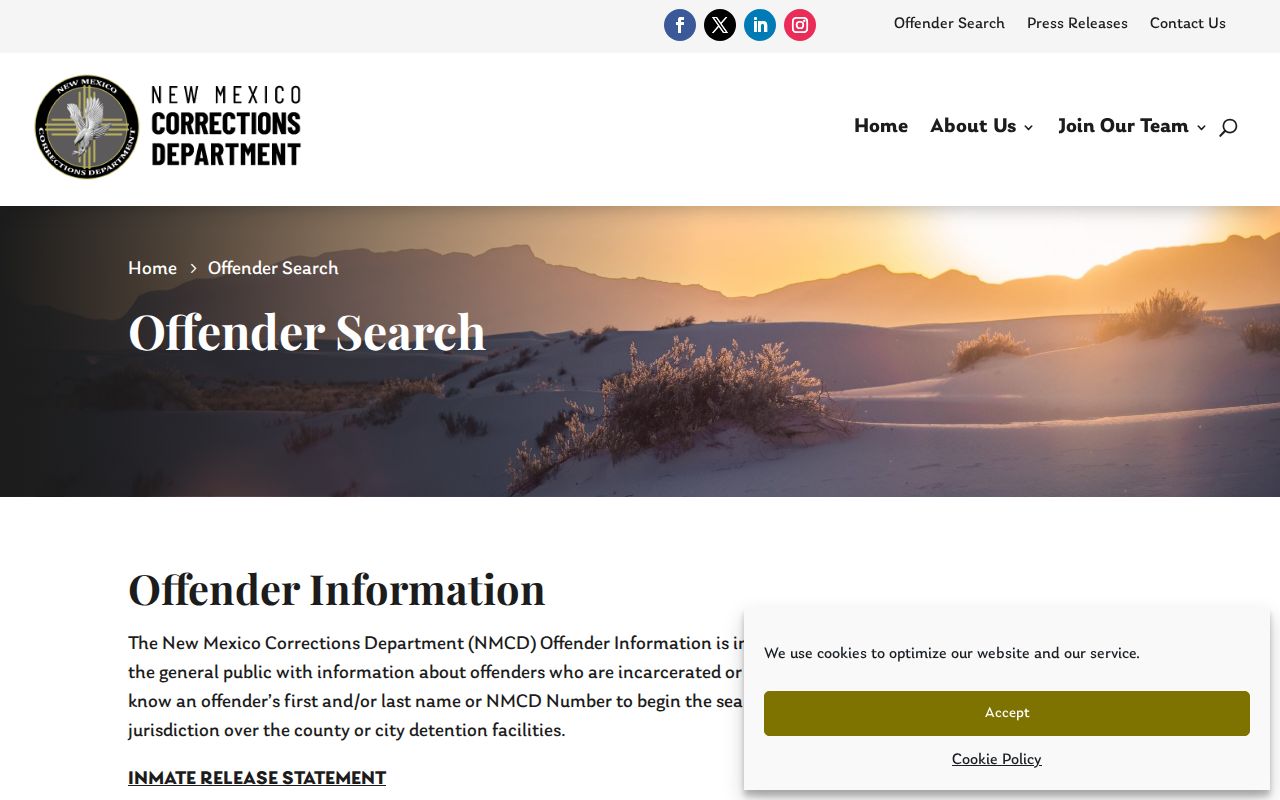
The image supports the state-prison route, not a county-jail release calculator.
New Mexico Earned Release Deductions
The Earned Meritorious Deductions Act, NMSA 1978 § 33-2-34, governs key NMCD sentence deductions. Rates and caps depend on the statutory offense category, offense date, conduct, and program eligibility. Some awards are monthly, while the statute also addresses specific lump-sum awards. Life and life-without-parole terms do not receive these deductions. The applicable version and classification must be checked for the individual judgment.
New Mexico does not impose a literal universal “85 percent” rule. For a serious violent offense, the current four-days-per-month maximum can yield roughly 86.85 percent service if the maximum deductions apply, and the person may serve more. State v. Rudolfo, 2008-NMSC-036, rejected the claim that the act or another New Mexico statute requires exactly 85 percent. Multiplying every sentence by .85 is therefore wrong.
Presentence confinement credit under NMSA 1978 § 31-20-12 can affect the unserved term when legally credited. Multiple cases and concurrent or consecutive judgments complicate that calculation. Concurrent terms run at the same time; consecutive terms run one after another. Only the filed judgments and official computation resolve which structure applies.
Note: A statutory maximum deduction is not a promise that a person earned every available day.
Why Quay Release Dates Change
NMCD’s projected-release-date change form lists several concrete reasons for a revision, including a low evaluation, forfeiture, lump-sum award, revocation of awarded deductions, and an amended judgment. The release-planning policy also calls for checks of calculations, credits, parole routes, victim notice, warrants, and detainers. Those controls show why a single date copied months in advance may become stale.
| Change | Possible effect | Best record |
|---|---|---|
| Earned deduction or lump-sum award | May move the projection earlier when lawfully posted | NMCD time computation and deduction record |
| Forfeiture or revoked award | May move the projection later | NMCD classification or disciplinary record |
| Amended judgment or corrected credit | Can change the base term or credited time | Filed court order and updated NMCD computation |
| Consecutive sentence | Adds a term that must be served in sequence | Judgment, sentence, and official computation |
| Parole decision or inadequate plan | Eligibility may not result in immediate departure | Adult Parole Board decision and release plan |
| Warrant, detainer, or receiving agency | May prevent community release or cause transfer | NMCD checklist and responsible-agency record |
Parole eligibility under NMSA 1978 § 31-21-10 is another distinct date. Eligibility means the Adult Parole Board may consider release. It does not mean parole was granted or that a prison exit will occur that day. Board action, a missing release plan, a legal hold, or a later event may change the practical outcome.
Confirm Quay County Actual Release
Near the projected date, check the source again. NMCD says Adult Prison Division information updates nightly and advises allowing time for updates, yet it also warns that people move and directs users to verify with the institution. The agency’s central release statement says certain central offices do not provide release updates or statuses, so use the division-specific search, institution, or records route rather than treating every NMCD phone line as a release desk.
A Quay County VINELink release alert can provide notice of a reported custody event where the agency participates and service is available. It is not the signed judgment, the time computation, or the final custody transaction. Read the event label and supplying agency, then confirm it.
For a county case, ask Quay County Detention Center whether departure meant community release or transfer. The court order may explain the authority but not the exact physical exit time. When precision matters, request the custody transaction with release date and time, recorded reason, releasing authority, and receiving agency if transferred. For a state sentence, request the appropriate NMCD record rather than asking the county to reconstruct state calculations.
The broader Quay County release-record search path separates the jail, court, NMCD, and federal systems when the final destination is uncertain.
No Quay Release Date Calculator
Quay County’s official detention page publishes facility operations and contact information, but no projected-date calculator or jail good-time policy. The absence is a meaningful local fact. An online estimate cannot account for a pending court decision, another case, a bond condition, a county sentence calculation, or a hold from another jurisdiction. Posted office hours also do not establish a release-processing schedule.
For a pretrial detainee, the court docket may show a bond or conditions order. That order creates legal authority, but it does not prove the bond was posted, processing finished, or all holds cleared. A dismissal in one case may leave another commitment in place. The detention transaction and direct confirmation answer the physical-custody question.
For NMCD, the serious-violent-offense deduction cap is also not a county calculator. Presentence credit, sentence structure, earned and forfeited deductions, parole action, amended judgments, and detainers can move the projected release date. The official computation is the proper source. Arrange critical plans only after the responsible agency confirms the actual event and destination.
Quay NMCD Release Date Computation
NMCD Records and Classifications is the state unit that determines release dates from judgments and sentences and posts earned or forfeited good time. The department’s sentence-computation policy includes a Change of Projected Release Date form with fields for the current and new date and the reason for the change. The release-planning policy uses a checklist that reviews the projected date, calculation, credit, parole or discharge route, victim notice, warrant, detainer, and final release destination.
Those controls show that the date is the output of a maintained record, not a number a reader can reproduce from a news report. The signed judgment supplies the sentence, but later amendments can alter it. Presentence credit must be lawfully applied. Earned meritorious deductions can be posted, withheld, forfeited, restored, or revoked. A new consecutive sentence changes the sequence, while a concurrent term may overlap another term. The agency must resolve those facts against the correct statutory version.
When requesting a state computation, provide the person’s full name, NMCD number, date of birth, and enough case information to isolate the record. NMCD’s Contact Us and IPRA page points formal public-record requests to NextRequest. Ask for an existing sentence computation or projected-date-change record to the extent public. Do not ask the public search page to perform a new calculation.
If a result screen presents a date, capture both its label and value. “Parole eligibility,” “projected release,” “tentative release,” and “discharge” are not synonyms. A date without its label is too easy to misstate.
Quay Court and Parole Dates
The court docket, NMCD time computation, and Adult Parole Board record describe different stages. A judgment and sentence defines the legal term. NMCD administers the time calculation. The parole board decides parole matters within its authority. A board eligibility date allows consideration, while a grant may still require an adequate release plan and clearance of holds. None of those dates alone proves that the prison gate event occurred.
No public inmate-by-inmate New Mexico parole hearing calendar or online person-level decision database was located. Public quarterly board-meeting notices are governance meetings, not individual hearing schedules. For a named person, request the releasable board record and confirm the result with NMCD. Qualifying victims use the separate written-notice route through the prosecuting District Attorney because VINELink registration does not automatically enroll them for board-hearing and NMCD release notices.
After a projected date passes, seek the actual state release event. If the record shows parole, confirm the assigned PPD office. If it shows transfer, follow the receiving system. If the person remains in custody, ask which official change moved the date. These checks keep Quay County projected release dates distinct from parole eligibility, court authority, and completed release.